As the site goes beyond more traditional means to get traffic by search engine optimization and paid advertising, social networks and data management services should become an important part of your strategy marketing research online. Learning to use blogs can help you create the links with your clients and raise your visibility in search engines.
We know that search engines are making changes to reflect changes in the market, as well as Internet gifted community. We can see this by how the major search engines modify the test results of these changes on the user community. Google organic search layout, for example, integrate data from video, news and podcasts in the natural results of search engine. Additional services such as personalized search, are available that can influence search engine results further towards the user's preferences or behaviors.
Organic search results represent an issue for search engine optimization since less screen real estate is available for text ads. May you find your listing pushed off the first page if you are not watching and executing better than the competition. Social media optimization is something you should consider now, if you have not already.
Blogs are an excellent first step. WordPress is an option that has an open source development and several cool and powerful plugins. You get an RSS feed and an infrastructure for integration, not only the content of the text, but also streaming video and audio podcasts.
To take full advantage of social media optimization, Here are six things you need to do:
1. Set up your WordPress blog.
If you are running a business and want to start creating your own blog authority, I recommend using a trusted partner like GoDaddy.com. It takes about 10 minutes to establish. Request an account hosted on Linux, because WordPress is not compatible with Windows. Unless you have a unique domain set up for this, I suggest adding the blog as a directory of your domain: your-site.com/name-of-blog-with-keywords. TypePad and Movable Type blog system are other free services. Blogger.com--Google 's platform - is free, and Yahoo! Small businesses have a variety of options to select as well.
2. Add contents.
Add a blog once a week or more to start. The frequency is important for search engines, and users expect to receive regular updates. When you add content, make sure to add the tags and category. Tags Directory support structures and show that the search engine on your computer. To get ideas for content, see the article directories EzineArticles.com and GoArticles.com. If you copy the entire text, the author of the bio box and be aware that you catch Google in May for duplication of content. A better solution is to start with story ideas, edit content and make comments about the article, while referencing the original author.
If you have more money than time, ask someone to RentACoder.com, Elance.com or Guru.com write for you. You can also search articles private label rights, but look for duplicate content, too. eBay has a large number of these types of articles, but try to do it yourself. If you're in the B2B space, we hope you have a good marketing and information-based materials, you can boost your blog.
3. Manage RSS feeds.
RSS is an easily monitored and managed based on XML that enables the structure of Web-compatible file system to read data. Get an account with Technorati.com and update your site feeds - also known as ping. You can also use FeedBurner.com OnlyWire.com and to help distribute content and PingOMatic.com Pingoat.com and alert systems that you have created a new position.
4. Promote your blog.
Always draw the search engines when you can. Perform keyword search firm to find out what people are searching for your niche. Use the keyword search and search for keyword phrases rather than starting with keywords the most competitive. Include these keywords in the titles of your posts.
If you are active in the online community, visit the other blogs and forums for dialogue and exchange links. Be sure to tag everywhere and try to get a listing on Digg.com and del.icio.us, reddit.com and MySpace.com. The educational content, such as "how to" articles, tend to be very popular.
5. Leverage videos and podcasts.
Podcasts are a simple way to provide more information and customizing your business or service. The MP3 format can be listened to easily listen on the web and your blog. You can podcast your files and to manage them via iTunes. You can also stream video of your visitors in homes and let them watch on their Apple TV, it recently announced a product.
6. Optimize your WordPress blog.
A blog should be optimized for users, search engines and income, in that order. A blog looking professional is important. Look for specific sites - a white background works well - at the WordPress Theme Viewer site. Some of the themes are less SEO-friendly than others. Add a form to capture names and e-mails to create your e-mail list. For SEO, change your permalinks to this custom option: /% year% /% monthnum% /% day% /%% postname / and allow customization of permalinks. This is a search engine friendly site that is commonly used.
As I mentioned earlier, WordPress has a number of powerful plug-ins to take into account. Here are a few to start with:
* Google Analytics - all tracks on all pages
* Chicklet - an array of social media tags for your users, including icons RSS reader
* AdSense Deluxe - publish ads on your site
* Google Sitemap Generator for WordPress - creates a sitemap for your site
* Akismet filtering - filter link spam from blog comments, WordPress API key required
* SEO Title Tag - simple optimization title tags in your WordPress blog
* Ultimate Tag Warrior - incorporates the tag name in the title pages to tagged pages
* PodPress - everything you need for podcasting
More plugins are available on the WordPress plugins directory.
After you've created, follow the basic rules for long-term success:
* Do not use Black Hat SEO - techniques unethical - to stuff keywords and duplicate content in your blogs.
* Providing value through quality of content. If you sell something, not be moved. Try to provide constructive feedback and education on products, services and competitors.
* Use the Chicklet you see on many blogs, including a large button for your RSS, so visitors and search engines can easily access your data.
* Place AdSense strategic components to generate the money for yourself, while still providing value. Do not big companies, including media like CNN. Match the text and color, with the presentation of your site. Over time, May you get a check from Google.
Showing posts with label blog. Show all posts
Showing posts with label blog. Show all posts
Tuesday, July 28, 2009

Thursday, July 9, 2009
Mistake of Bigadda or Gulsan Grover?

I am a fan of Gulshan Grover (bad man) and I love his line 'Jeene Ka Maza To Khatte Mein Hee Hai'. Recently, a friend of mine told me that Gullu has started his own blog at BigAdda on the lines of BigB. I visited the blog gulshangrover[dot]bigadda[dot]com to see what's in there for me. I was surprised to note that the very first, and only, post of Gullu had the timestamps December 30, 2009. Yes, December 30, 2009, and today is July 9, 2009. But, amazingly, on the lines of writing a diary, Gullu wrote the place & time of writing the post as December 28, 2008. It's bad BigAdda guys.... hope you are listening.
Tuesday, June 30, 2009
Internet Marketing Tricks - SEO Blogging
As the Internet marketing beyond more traditional means of getting traffic via search engine optimization and paid advertising, social networks and related data management services should become an important part of your online search marketing strategy. Learning how to use blogging can help you create authority, connect better with your customers and lift your visibility in the search engine results.
We know that search engines are making changes to accommodate for shifts in the marketplace, as well as a more internet-savvy community. We can see this by the way the top search engines change results and test those changes on the user community. Google's universal search layouts, for instance, embed data from video, news and podcasts in the natural search engine results. Additional services, such as personalized search, are available that allow for search engine results swayed more toward user preferences or behaviors.
Blogs are a great first step. WordPress is a popular option that has an open source development community and several cool and powerful plugins. You get an RSS feed infrastructure and a place for embedding not only text content, but also video streaming and audio podcasts.
To take full advantage of social media optimization, here are six things you should do:
1. Set up your WordPress blog.
If you're running a business and want to start building your own authoritative blog, I recommend using a trusted hosting partner like GoDaddy.com. It takes about 10 minutes to set up. Apply for a Linux-hosted account, since WordPress isn't compatible with Windows. Unless you have a unique domain set up for this, I suggest adding the blog as a directory of your domain: your-site.com/name-of-blog-with-keywords. TypePad and the Movable Type blog system are other free services. Blogger.com--Google's platform--is free, and Yahoo! Small Business has a variety of options to select from as well.
2. Add content.
Add a blog post once every week or more to start. Frequency is important to search engines, and users will come to expect regular updates. When you add content, make sure you add the tags and category. Tags and directory structures help show the search engines what your post is about. To get ideas for content, look up article directories EzineArticles.com and GoArticles.com. If you copy the entire text, include the author's bio box and be aware that Google may catch you for duplication of content. A better way is to start with the article ideas, change the content and make comments about the article, while still referencing the original author.
If you have more money than time, have someone from RentACoder.com, Elance.com or Guru.com write it for you. You can also look into private label rights articles, but watch for duplicate content there, too. eBay has a lot of these types of articles available, but try to make them your own. If you're in the B2B arena, you hopefully have good marketing and information-based materials you can reinvigorate for your blog.
3. Manage RSS feeds.
RSS is an easily tracked and managed XML-based file structure that allows compatible web systems to read the data. Get an account with Technorati.com and update them with your site feeds--also known as pinging. You can also use FeedBurner.com and OnlyWire.com to help distribute content and PingOMatic.com and Pingoat.com to alert systems that you've made a new post.
4. Promote your blog.
Always leverage the search engines when you can. Conduct solid keyword research to find out what people are searching for within your niche. Use the Keyword search tool and look for longer keyword phrases rather than starting with the most competitive keywords. Include these keywords in the titles of your posts.
If you're active in the online community, visit related forums and other blogs to exchange dialogue and links. Make sure to tag everywhere and try to get a listing on Digg.com, stumbleupon.coom, as well as del.icio.us, reddit.com and MySpace.com. Educational content, such as "how to" articles, tend to be very popular.
5. Leverage podcasts and videos.
Podcasts are a simple way to provide more detail and personalization around your company or service. The MP3 format can easily be streamed for listening on the web and from your blog. You can podcast your files and even manage them via iTunes. You also can stream video into your visitors' homes and let them watch it on their Apple TV, a recently announced product.
6. Optimize your WordPress blog.
A blog should be optimized for users, search engines and income, in that order. A professional-looking blog is important. Look for clean sites--a white background works well--at the WordPress Theme Viewer site. Some of the themes are less SEO-friendly than others. Add a form to capture names and e-mails to build your e-mail list. For SEO, change your permalinks to this custom option: /%year%/%monthnum%/%day%/%postname%/ and enable the customizable permalinks. This is a search-engine friendly URL that's commonly used.
Happy Blogging!!
We know that search engines are making changes to accommodate for shifts in the marketplace, as well as a more internet-savvy community. We can see this by the way the top search engines change results and test those changes on the user community. Google's universal search layouts, for instance, embed data from video, news and podcasts in the natural search engine results. Additional services, such as personalized search, are available that allow for search engine results swayed more toward user preferences or behaviors.
Blogs are a great first step. WordPress is a popular option that has an open source development community and several cool and powerful plugins. You get an RSS feed infrastructure and a place for embedding not only text content, but also video streaming and audio podcasts.
To take full advantage of social media optimization, here are six things you should do:
1. Set up your WordPress blog.
If you're running a business and want to start building your own authoritative blog, I recommend using a trusted hosting partner like GoDaddy.com. It takes about 10 minutes to set up. Apply for a Linux-hosted account, since WordPress isn't compatible with Windows. Unless you have a unique domain set up for this, I suggest adding the blog as a directory of your domain: your-site.com/name-of-blog-with-keywords. TypePad and the Movable Type blog system are other free services. Blogger.com--Google's platform--is free, and Yahoo! Small Business has a variety of options to select from as well.
2. Add content.
Add a blog post once every week or more to start. Frequency is important to search engines, and users will come to expect regular updates. When you add content, make sure you add the tags and category. Tags and directory structures help show the search engines what your post is about. To get ideas for content, look up article directories EzineArticles.com and GoArticles.com. If you copy the entire text, include the author's bio box and be aware that Google may catch you for duplication of content. A better way is to start with the article ideas, change the content and make comments about the article, while still referencing the original author.
If you have more money than time, have someone from RentACoder.com, Elance.com or Guru.com write it for you. You can also look into private label rights articles, but watch for duplicate content there, too. eBay has a lot of these types of articles available, but try to make them your own. If you're in the B2B arena, you hopefully have good marketing and information-based materials you can reinvigorate for your blog.
3. Manage RSS feeds.
RSS is an easily tracked and managed XML-based file structure that allows compatible web systems to read the data. Get an account with Technorati.com and update them with your site feeds--also known as pinging. You can also use FeedBurner.com and OnlyWire.com to help distribute content and PingOMatic.com and Pingoat.com to alert systems that you've made a new post.
4. Promote your blog.
Always leverage the search engines when you can. Conduct solid keyword research to find out what people are searching for within your niche. Use the Keyword search tool and look for longer keyword phrases rather than starting with the most competitive keywords. Include these keywords in the titles of your posts.
If you're active in the online community, visit related forums and other blogs to exchange dialogue and links. Make sure to tag everywhere and try to get a listing on Digg.com, stumbleupon.coom, as well as del.icio.us, reddit.com and MySpace.com. Educational content, such as "how to" articles, tend to be very popular.
5. Leverage podcasts and videos.
Podcasts are a simple way to provide more detail and personalization around your company or service. The MP3 format can easily be streamed for listening on the web and from your blog. You can podcast your files and even manage them via iTunes. You also can stream video into your visitors' homes and let them watch it on their Apple TV, a recently announced product.
6. Optimize your WordPress blog.
A blog should be optimized for users, search engines and income, in that order. A professional-looking blog is important. Look for clean sites--a white background works well--at the WordPress Theme Viewer site. Some of the themes are less SEO-friendly than others. Add a form to capture names and e-mails to build your e-mail list. For SEO, change your permalinks to this custom option: /%year%/%monthnum%/%day%/%postname%/ and enable the customizable permalinks. This is a search-engine friendly URL that's commonly used.
Happy Blogging!!
Tuesday, April 28, 2009
What's going on with google analytics
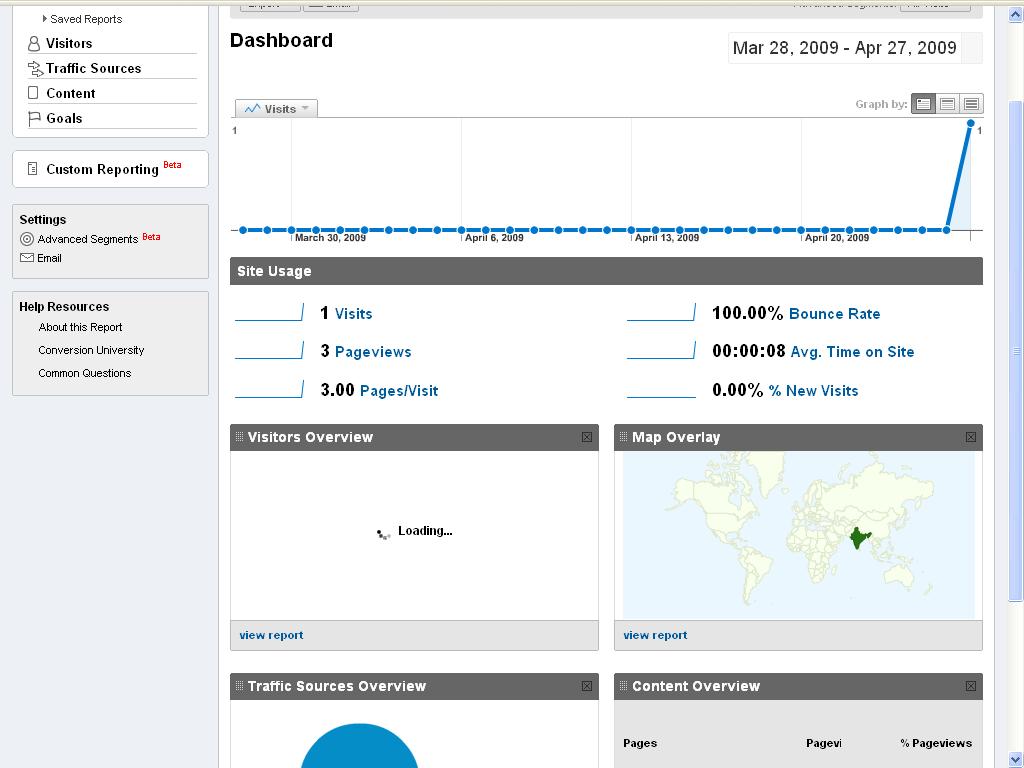
I setup a blog and did its google analytics yesterday. But today when I was browsing my google analytics account I was Shocked!
According to above picture my blog got 1 visit, and pageview is 3. It means my bounce rate should be 0% but the google analytics showing that it is 100% how can it is possible.
According to google analytics help, bounce rate definition is following:Bounce rate is the percentage of single-page visits or visits in which the person left your site from the entrance (landing) page.
Referance url-http://www.google.com/support/analytics/bin/answer.py?hl=en&answer=81986
Is google analytics lacking somewhere or it is google's bounce rate calculation algorithm bug. I am surprised!
Subscribe to:
Posts (Atom)
